
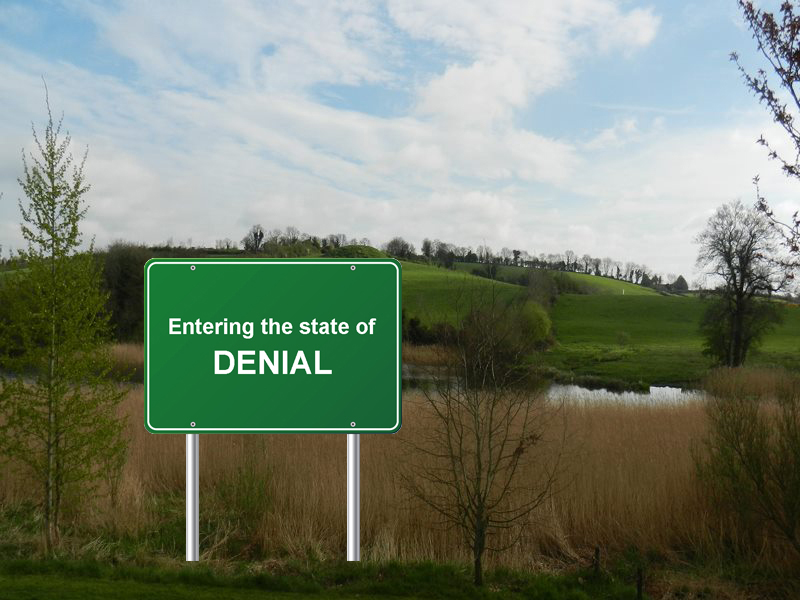
Entering the State of Denial
Anyone wishing more information can email me at stancourtney@gmail.com
Surname changes are an
ongoing problem in genealogy. When knowledge of the surname changes
become known to genealogical researchers they respond differently.
Three examples:
First case:
I had numerous
emails with a male Courtney who was enthusiastic about tracing his
male line. He shared his grandparents names with me and I attempted
to find them in the Courtney Worldwide Database. The names were quite
unusual and I was surprised when I was not able to find any
documentation. Eventually I solved the mystery. His grandfather left
his home, changed his surname, married and had two children. He later
left his 1st wife, changed his first name and remarried. I explained
to the individual about my findings and about his original surname.
But he wanted nothing more to do with genealogy.
Second
case:
Non
parental event (NPE's)
is defined in Wikipedia as “In genetics, a non-paternity event
(also known as misattributed paternity, not parent expected, or NPE)
is when someone who is presumed to be an individual's father is not
in fact the biological father .” Various rates for NPE's has
been suggested as from one to two percent.
Lewis Courtney
(1793-1855) married Margaret Reed (1791-1870) in 1818 in Clark
County, Kentucky. At the time of her marriage she had two male
children aged 6 and 2 years of age, who later went by the surname of
Courtney. Three descendants of the oldest son YDNA tested, and
matched each other but none matched any Courtneys. A descendant from
a younger brother born in 1824 also tested. He matched the James
Courtney 1610 Virginia group. The obvious conclusion is that only the
children born after the marriage of Lewis Courtney and Margaret Reed
were Courtney descendants. Two of the YDNA testers denied the testing
results, one dropped out of the Courtney DNA Project, and both
continue to inaccurately show Lewis Courtney in their family trees.
Third case:
Emanuel Courtney
1785-1852) is a brick wall for genealogy but not for genetics. His
male descendant tested YDNA, the results showed that although he did
match several other Courtneys he was not a descendant of Robert of
Onslow, as all the published genealogies suggest. The testers
response was “I have researched this line for 50 years and now
I find out that I am wrong”. I contacted many of Emanuel's
descendants on Ancestry and explained the YDNA discovery but I got no
responses and the family trees continue to show the incorrect
lineage.
My own case:
My great-grandfather Edward
Courtney was an Irish immigrant living in upper New York State in
1850. In the early 1980's I hired a local genealogist to do research
in the area. She came back with the information that the name in the
1850 census was Callen, not Courtney. I had information from
baptismal records in Ireland showing the name as Courtney, and
immigration records in 1847 for New York City also showed Courtney.
So I assumed incorrectly that the 1850 census taker had made a
mistake. As this was a time before the internet it was very difficult
to cross check information. Although the surname is found in Ireland
it is usually a variation of Cournane or McCourt. I eventually found
land records and the name was in fact Callan. For some reason the
family had taken the surname of Courtney, probably for the reason of
getting jobs with a more English sounding name. My own YDNA showed
no Courtney connections.
In conclusion all of the examples
show the power of YDNA testing. I am unqualified to explain why
people (including myself) are slow to accept when genealogies are
shown to be inaccurate.